On this page
- Old Town Walls and Street Art: Reading Ipoh’s Layered History
- Limestone Cave Temples: Sacred Spaces in the Karst
- The Ipoh Food Scene: What to Eat and Where
- New Wave Cafés in the Old Town: Creative Economy After 2020
- Getting to Ipoh and Getting Around in 2026
- 2026 Budget Reality: What Things Cost in Ipoh
- Frequently Asked Questions
💰 Click here to see Malaysia Budget Breakdown
💰 Prices updated: August, 2026. Budget figures are estimates — always verify before travel.
Exchange Rate: $1 USD = RM4.03
Daily Budget (per person)
Shoestring: RM100.00 – RM200.00 ($24.81 – $49.63)
Mid-range: RM180.00 – RM400.00 ($44.67 – $99.26)
Comfortable: RM450.00 – RM1,300.00 ($111.66 – $322.58)
Accommodation (per night)
Hostel/guesthouse: RM20.00 – RM70.00 ($4.96 – $17.37)
Mid-range hotel: RM100.00 – RM350.00 ($24.81 – $86.85)
Food (per meal)
Budget meal: RM15.00 ($3.72)
Mid-range meal: RM35.00 ($8.68)
Upscale meal: RM100.00 ($24.81)
Transport
Single metro/bus trip: RM2.00 ($0.50)
Monthly transport pass: RM150.00 ($37.22)
Ipoh has spent years being called a “day trip destination” — and that label has done the city a disservice. Since the mid-2020s, a combination of restored shophouses, a maturing café culture, and renewed interest in Perak’s food traditions has turned Ipoh into one of the most rewarding two-night stops in Peninsular Malaysia. The 2026 pain point is this: most visitors still arrive on the morning ETS train, walk Concubine Lane, eat one bowl of white curry mee, and leave by late afternoon. This guide is written for the person who wants to do better than that.
Old Town Walls and Street Art: Reading Ipoh’s Layered History
Ipoh’s Old Town sits on the west bank of the Kinta River, and its character comes from the fact that it was built on tin money — fast, lavish, and very aware of status. The Edwardian and art deco facades along Jalan Sultan Iskandar and Jalan Bandar Timah are not restored replicas. Many are original structures, some still occupied by the same families who have owned them since the early 20th century. Walk slowly here. The patina on the green wooden shutters, the hand-painted signage for long-closed sundry shops, the worn ceramic floor tiles visible through open doorways — these are not curated for tourism.
The street art scene, which began in earnest around 2013 following Penang’s model, has matured considerably. By 2026, the works that have survived are genuinely good — particularly the Ernest Zacharevic-inspired murals near Jalan Panglima and the newer geometric pieces along Jalan Treacher added during the 2024 Ipoh Heritage Trail expansion. A self-guided walking map is available free from the Ipoh Tourism Information Centre on Jalan Bandar Timah. The walk covers about 3 kilometres and takes a comfortable 90 minutes if you stop to look properly.
The Birch Memorial Clock Tower at the junction near the Town Hall is worth a pause — not just as a photo stop, but because the relief carvings around its base depict scenes of British colonial ambition in a way that looks quite different now than it did when they were installed in 1909.
Limestone Cave Temples: Sacred Spaces in the Karst
Ipoh sits inside a valley ringed by limestone karst hills, and the Perak Chinese community has been building temples inside these caves for well over a century. The most visited is Sam Poh Tong, about 5 kilometres south of the city centre on Jalan Gopeng — an active Taoist-Buddhist monastery where turtles move slowly through a pond set inside a natural cave opening, and the air smells of cool stone and incense smoke. It is genuinely atmospheric, especially if you arrive before 9am when tour groups are still absent.
Perak Tong, about 6 kilometres north of the city centre on Jalan Kuala Kangsar, is older and quieter. It holds over 40 Buddha statues and a series of murals painted by visiting Chinese artists across the decades. A steep internal staircase — 385 steps — leads to a small opening at the top of the hill with views over the Kinta Valley and the patchwork of limestone outcrops. The climb takes about 15 minutes and is worth every step.
Neither temple charges admission. Dress modestly — covered shoulders and knees as a baseline. Both are reachable by Grab from the Old Town for under MYR 15 each way.
The Ipoh Food Scene: What to Eat and Where
Ipoh has legitimate culinary claims that go beyond regional pride. Three dishes in particular are specific enough to this city that eating them elsewhere is a different experience entirely.
Ipoh white curry mee is made with a broth that is coconut-rich but clear, almost translucent white, and layered with bean sprouts, shredded chicken, and prawns. The bean sprouts grown in Ipoh are famously crunchier and sweeter than elsewhere — locals credit the limestone-filtered water. For the benchmark version, go to Restoran Onn Kee on Jalan Yau Tet Shin, open from early morning until late lunch. Arrive before 8am or expect a queue.
Nga Choy Kai — poached chicken with bean sprouts — is served at dozens of shops but Lou Wong on Jalan Yau Tet Shin has been doing it the longest and most consistently. The chicken arrives at the table silky and yielding, the bean sprouts still firm, with a light soy and sesame dipping sauce that does not overpower.
Ipoh dim sum deserves its own mention. The morning dim sum culture here is distinct from KL — smaller shops, more traditional preparation, less pressure to turn tables. Foh San on Jalan Leong Sin Nam is the most famous, a large corner restaurant that has been serving since 1973. The char siew pao and the prawn cheung fun are the benchmark. Go before 9am on weekdays — by 10am on weekends, the wait for a table can stretch to 45 minutes.
For evening eating, the hawker stalls along Jalan Mustapha Al-Bakri (commonly called the New Town hawker area) offer a Malay-Chinese mix including good nasi ganja — a local term for the intensely spiced nasi kandar-style rice that Ipoh’s Mamak community has made their own.
New Wave Cafés in the Old Town: Creative Economy After 2020
The café scene that began transforming Ipoh’s Old Town in the late 2010s has settled into something more interesting by 2026 — less Instagram-bait, more genuinely local. The early wave of mason-jar-and-exposed-brick cafés has thinned out, leaving behind the operations with actual roots in the community.
Plan B Ipoh on Jalan Sultan Iskandar continues to hold its ground as a reliable all-day café with quality coffee and a menu that uses local produce. More compelling now is Mural Café, which operates inside a restored pre-war shophouse and doubles as a gallery space for local artists. The coffee is serious — single-origin, locally roasted — and the back wall of rotating artwork changes every six to eight weeks.
Funny Mountain Soya Bean is not a café in the modern sense, but it belongs in this section: a street stall on Jalan Theatre that has been selling cold soya bean milk and tau fu fah (silken tofu with ginger syrup) since the 1950s. In 2026 it still operates from the same location, the condensation dripping off the cold metal tanks in the afternoon heat. A cup costs MYR 2.50. It is one of the most refreshing things you can drink in Malaysia after a long walk in 33-degree heat.
Getting to Ipoh and Getting Around in 2026
One full day is enough to touch the surface of Ipoh. Two nights is what it takes to eat properly, visit the cave temples without rushing, and spend an evening at the hawker stalls. Day-trippers from KL typically take the 7:30am or 8:00am train from KL Sentral, arrive by 10am, and return on a late-afternoon service — enough to cover the Old Town, one cave temple, and a proper lunch. A second night opens up the evening hawker scene and a slower morning dim sum experience.
The ETS (Electric Train Service) from KL Sentral remains the most comfortable and reliable option. In 2026, the ETS Platinum service runs multiple daily departures and the journey takes approximately 2 hours 5 minutes. Tickets range from MYR 35 to MYR 55 for standard class depending on the service time and how far in advance you book through the KTM website or app. Book at least two days ahead on weekends — the Ipoh route fills up. Express buses also run from KL and Penang for MYR 20–35. From Penang, the ETS takes around 1 hour 45 minutes south.
Ipoh’s Sultan Azlan Shah Airport handles a small number of domestic flights from Kuala Lumpur (about 45 minutes) operated by Firefly and AirAsia. These are useful if you are continuing north into Perak’s interior or connecting without going through KL, but for most travellers the train is faster door-to-door.
Within Ipoh, Grab is the primary way to reach destinations outside the Old Town walking area — cave temples, New Town food stalls, the train station. The Old Town itself is entirely walkable. Bicycle rental is available from a couple of Old Town cafés for MYR 15 to MYR 25 per day, which suits the pace of the area well. There is no functioning city bus network that usefully serves tourists in 2026.
2026 Budget Reality: What Things Cost in Ipoh
Ipoh remains one of the most affordable mid-sized cities in Malaysia, and that gap with KL and Penang has widened slightly as those cities’ costs have risen.
- Budget accommodation (hostel dorm, basic guesthouse): MYR 45–90 per night
- Mid-range accommodation (heritage boutique hotel, clean en-suite): MYR 150–280 per night
- Comfortable accommodation (well-restored heritage property, full amenities): MYR 300–500 per night
- Hawker meal (bowl of white curry mee, drink): MYR 10–16
- Dim sum breakfast for two (Foh San, with tea): MYR 40–70 depending on how many dishes
- Specialty café coffee: MYR 12–18
- Grab ride within city: MYR 8–20 depending on distance
- ETS ticket KL–Ipoh (one way, standard): MYR 35–55
- Cave temple visits: Free (donations welcome)
A realistic two-night trip from KL, including transport, mid-range accommodation, and eating properly at hawker stalls and one or two cafés per day, comes to approximately MYR 500–700 per person. Budget travellers can do it for MYR 300–400 without sacrificing the food experience, which is the whole point.
Frequently Asked Questions
How many days do you need in Ipoh?
Two days and one night is the practical minimum for a satisfying visit — enough time to cover the Old Town street art, one or two cave temples, and eat the key dishes without rushing. A second night opens up the evening hawker scene and a slower morning dim sum experience.
Is Ipoh worth visiting in 2026, or has it become too touristy?
Ipoh has seen growing visitor numbers, particularly from domestic tourists and Singaporeans, but it has not tipped into over-tourism. The Old Town gets crowded on weekend mornings, but the cave temples remain peaceful early in the day. The food scene is entirely genuine — locals eat at the same hawker stalls as visitors, which keeps standards honest.
What is the best way to get from Kuala Lumpur to Ipoh?
The ETS Platinum train from KL Sentral is the best option — comfortable, punctual, and central on both ends. The journey takes around 2 hours 5 minutes in 2026. Driving is an option if you plan to explore Perak’s interior, but parking in Ipoh Old Town is difficult on weekends. Express buses also run from KL and Penang for MYR 20–35.
What food is Ipoh most famous for?
Three dishes define Ipoh’s food identity: white curry mee (a coconut-based broth with a distinct local character), nga choy kai (silky poached chicken with crunchy local bean sprouts), and dim sum — particularly at longstanding morning establishments like Foh San, which has been serving since 1973.
Where should you stay in Ipoh — Old Town or New Town?
Stay in or immediately adjacent to the Old Town. It puts you within walking distance of the street art, the heritage buildings, and most of the serious eating. New Town has more standard hotel options but requires transport to reach the main attractions. By 2026, enough quality boutique accommodation exists in the Old Town to suit most budgets.
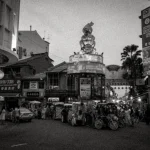
📷 Featured image by Colin + Meg on Unsplash.